
How Zoho, the bootstrapped giant, is redefining enterprise software in Australia
A story of localisation, customer focus, and global scale

"Zoho wants to do for global businesses what it did for itself: develop, manage, and grow a sustainable, profitable company without incurring huge debts or losing ownership stake."
Context & Opportunity
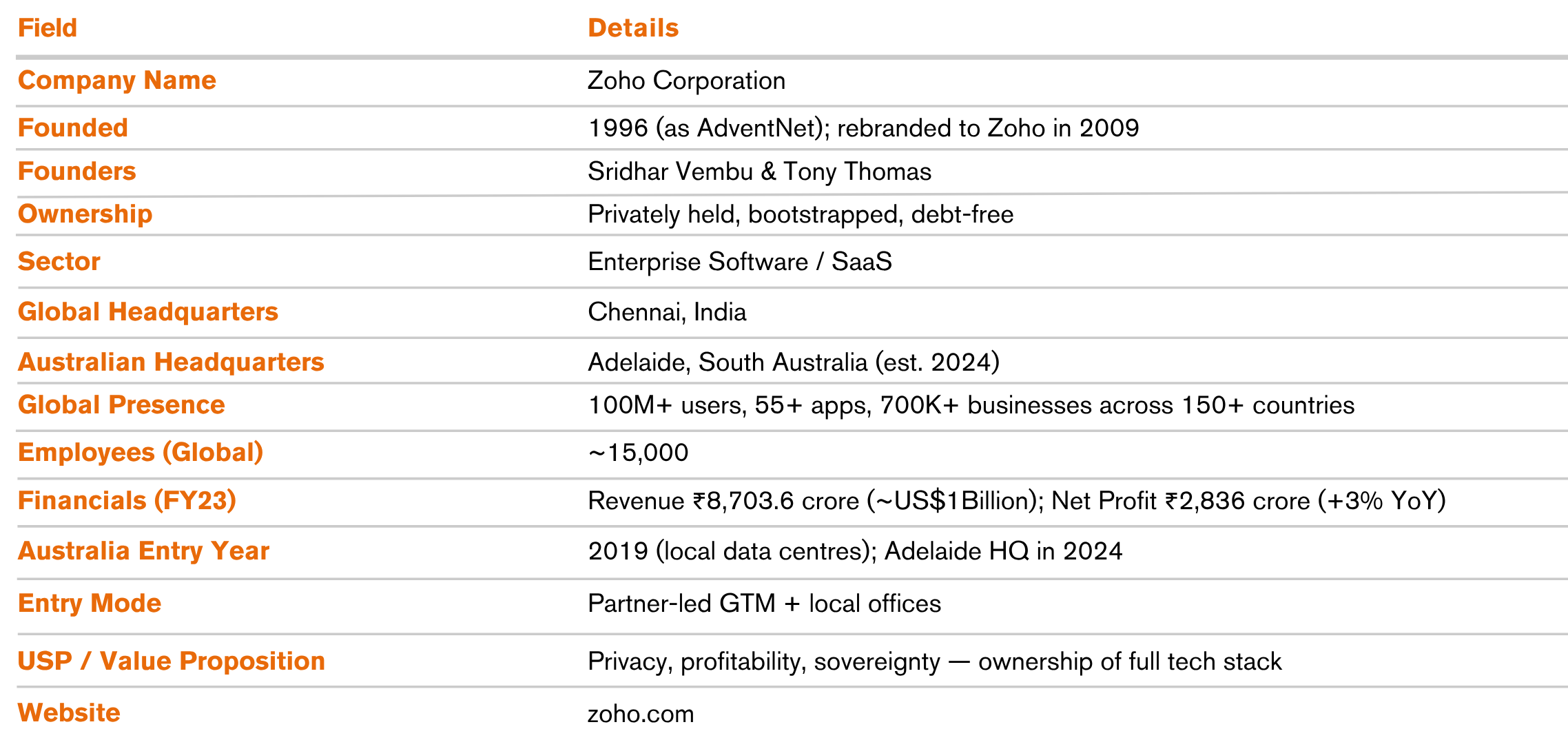
Founded in 1996 as AdventNet by Sridhar Vembu and Tony Thomas, Zoho’s journey began with a humble goal: to not go out of business. This foundational principle forged a unique corporate DNA rooted in fiscal discipline and long-term vision. The company was entirely bootstrapped, profitable, and debt-free, crossing $350K in sales by 1997. This refusal to take outside capital, which continued after rebranding to Zoho in 2009, became a core tenet. It allowed Zoho to weather economic downturns like the dot-com bubble and reinvest profits into R&D, fuelling innovation without external pressure. The company’s unique selling proposition is built on the core values of privacy, profitability, and sovereignty.
This philosophy found a strategic match in Australia. Before a formal launch, Zoho had already spent a decade serving Australian customers, gaining crucial market understanding. Its official market launch, which occurred amidst global Covid lockdowns, was built upon foundational investments like its local data centres established in 2019.
The Australian market showed a strong appreciation for data sovereignty. This aligned perfectly with Zoho’s ownership of its entire tech stack, which ensures customer data privacy and security. The convergence of Zoho's values with market conditions and buyer priorities in Australia created credibility and trust that enabled Zoho to establish a significant local presence.
Strategy & Execution
Nuanced Entry Strategy
Zoho translated its foundational principles into a nuanced and adaptive market-entry strategy for Australia, prioritising long-term trust over short-term gains.
Rather than a direct, high-capital entry, Zoho chose a model that mirrored its global success: leveraging its broad network of channel partners. This was a proven strategy, as local partners had been collaborating with Zoho's teams in India to acquire Australian customers since 2012. The rationale was clear: customers trust local partners who understand regional nuances and can provide accessible, robust support.
Zoho completed this partner-led model by establishing a direct presence, beginning with local data centres to address the critical issue of data sovereignty, which is a key purchasing driver for Australian businesses. This hybrid model combined the scale of a global corporation with the trust and agility of local expertise.
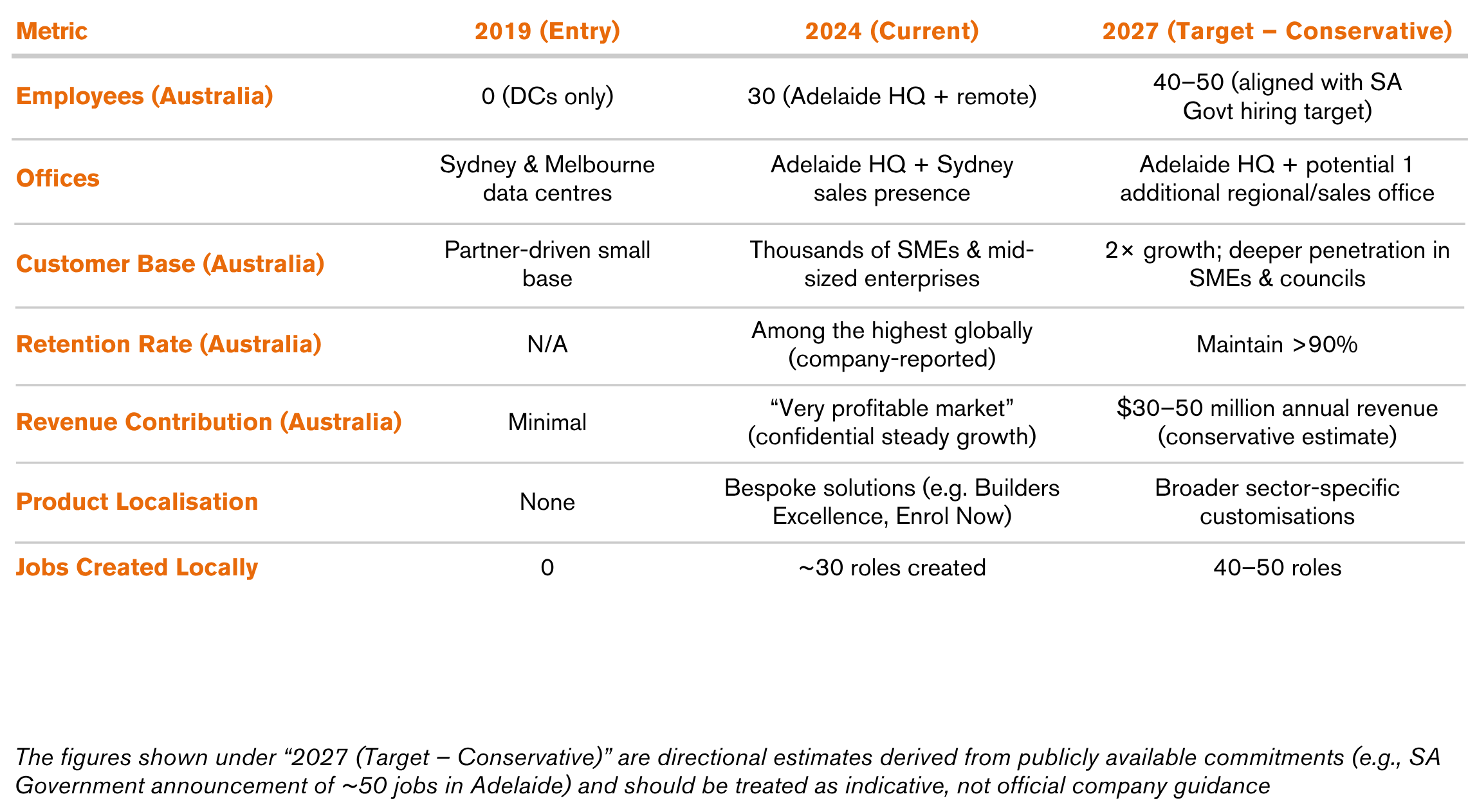
Zoho’s on-ground execution was marked by a significant strategic pivot. The initial plan was to establish its first office in Sydney. However, the company faced hiring challenges due to "The Great Resignation" sweeping the country. Observing that significant tech talent from Adelaide was migrating to states like NSW and Victoria, Zoho made the agile decision to open its first office in Adelaide instead. This move provided an opportunity for local talent to remain close to their roots and proved highly successful, with 30 employees hired in the Adelaide office.
This people-first localisation extended to culture and branding. Zoho leaned heavily on its Australian employees to shape how the company communicated, branded itself, and conducted business, ensuring an authentic alignment with local customs.
On the product front, while Zoho's extensive suite of over 55 apps often meets customer needs out of the box, the company demonstrated a commitment to deep localisation by creating bespoke solutions. For instance, it worked with a local partner to create "Builders Excellence," a custom Zoho for Construction solution tailored to the Australian market. Another example is "Enrol Now," a solution designed to help Australian preschools and councils manage enrolments efficiently.
The market-entry strategy was developed in-house through a blend of qualitative and quantitative analysis. The established channel partner network provided on-the-ground insights, while Zoho’s internal team of data analysts and market research specialists collated and analysed this data alongside public information and comprehensive reports from the Australian Bureau of Statistics (ABS). To overcome the challenge of building local trust as a global entity, Zoho actively embedded itself in the local business ecosystem. The company partnered with tech associations and industry bodies, became a member of business chambers, and participated in community events to build credibility from the ground up.
"Despite being a global company with over 100+ million users, entering a new market requires building local trust. A referral by a friend means more than corporate revenue numbers.
Impact & Results
Zoho’s strategic and culturally attuned entry into the Australian market has yielded significant growth and financial returns that validate its patient, value-driven approach. Because the company entered with an existing base of partners and customers, Zoho was able to achieve a return on investment quickly.
Zoho reports that the customer retention rate in Australia is "one of the highest across the world." This high retention indicates strong product-market fit and customer satisfaction. The growth is best described as "steady," and the expanding footprint has brought Zoho's continued investment and commitment to ensure local support remains easily accessible for a growing customer base.
Zoho’s presence has had a tangible impact on the local job market. Between Zoho Corporation and its division Manage Engine, the company has generated close to 60 jobs in Australia across key functions like sales, pre-sales, support, and marketing.
The Australian expansion has created a positive feedback loop. The presence of local product experts has been instrumental in retaining customers for longer periods by ensuring clients are well-supported and satisfied. Furthermore, the lessons learned in Australia have directly influenced Zoho’s global strategy. The company showed how getting localised messaging right and defining clear product learning journeys help win customers faster. This insight is now being applied in other international markets, where Zoho is engaging channel partners to understand local business pain points more deeply and tailor messaging accordingly.

"Your company’s culture will define your longevity in the market. Think about how you want your company to be perceived, and culture puts it all into perspective.
Lessons & Insights
Market Entry & Strategy
Despite being a global company with 100M+ users, Zoho found that global scale did not automatically translate into local trust.
In Australia, personal referrals and community credibility mattered more than revenue numbers or global reputation.
Zoho pivoted to grassroots engagement, partnering with local tech associations, business chambers, and industry bodies, while hosting value-driven events to build an organic referral base.
Core Takeaway
In mature markets, local embedding and community proximity build credibility faster than global credentials.
Government and ecosystem leverage
Ecosystem engagement through Australian tech associations, industry groups, and chambers proved more valuable than traditional marketing campaigns.
These platforms amplified Zoho’s visibility, created referral networks, and provided credibility in a competitive SaaS market.
Core Takeaway
In price-sensitive yet quality-conscious markets, balancing value and credibility drives adoption.
Market positioning and customer strategy
Zoho differentiated by positioning itself as a cost-effective yet enterprise-grade SaaS alternative, appealing to Australian SMEs looking for value without compromising reliability.
Customer acquisition was rooted in trust-building and long-term relationship orientation rather than aggressive sales.
Core Takeaway
In price-sensitive yet quality-conscious markets, balancing value and credibility drives adoption.
Organisation and capability building
The “Great Resignation” derailed initial hiring plans in Sydney; Zoho adapted by shifting to Adelaide, unlocking an untapped talent pool.
To solve graduate hiring gaps, Zoho recruited from unconventional sources, TAFE graduates and non-traditional backgrounds and then invested in in-house training.
Cross-cultural team alignment was achieved by flying the entire Australian staff to India for immersive onboarding and relationship building.
Core Takeaway
Agile talent strategies and cultural immersion are critical to sustaining cross-border operations.
Broader lesson for cross-border business
Zoho’s Australian journey underscores that scale and global reputation must be translated into local trust, adaptive hiring, and cultural alignment.
Core Takeaway
External validation from trusted local networks accelerates market acceptance in new geographies.
Zoho’s foundation in Australia is firmly established, and its focus for the next three to five years is on strategic, sustainable growth. The company plans to deepen its investment in the region and expand its brand footprint, primarily by strengthening its collaboration with local partners and resellers.
A key pillar of the future strategy is to aggressively demonstrate the superior value of its products compared to incumbent legacy systems, which are often associated with prohibitive costs. Zoho aims to position itself as the smarter, more accessible alternative in a market where companies are searching for ways to maximise the value of enterprise software. As they say within the company, "good software shouldn't be so expensive."
Being completely bootstrapped provides Zoho the freedom to continuously reinvest its earnings back into research and development. This will fuel further innovation tailored to the evolving needs of Australian customers and ensure that the company's strategic bet on the Australian market continues to generate value for both Zoho and the local businesses it serves.

All information has been verified from primary company submissions, official filings, interview transcripts, and secondary materials cited in the References section.
Company Snapshot
KPI Impact Snapshot