
How Wipro Became a AI-Powered Digital Transformation Partner to Leading Australian Companies
Story of localisation, innovation and cross border trust
Context & Opportunity

Wipro is a defining case study of strategic transformation and global expansion. Wipro, a global leader in AI-powered technology services, is renowned for driving complex digital transformation and innovation across industries. With a presence in 65 countries and a workforce of over 230,000, Wipro partners with clients to build future-ready, sustainable businesses through consulting, design, engineering, and operations. Established in 1945, Wipro’s rich heritage and decades of expertise have shaped its evolution into a trusted partner for enterprises worldwide. Wipro leveraged its global technology expertise to introduce innovative delivery models that combined local talent with international best practices, supporting job creation and digital capability building within Australia.
The timing of Wipro's Australian entry in 2000 represented a perfect confluence of global technological anxiety and India's emerging IT prowess. Indian software exports surged from US$1 billion in 1997 to US$6.2 billion by 2001. Australia's economy recorded strong 4.3% growth in 1999-2000, well above expectations. The Reserve Bank of Australia noted that financial markets were significantly affected by Y2K preparations throughout 1999. In 1999, the Australian IT market was experiencing rapid growth and faced a shortage of skilled IT manpower. This shortage created a demand for technology expertise and services, aligning with Wipro's capabilities in executing IT projects, talent placement, and offshore work. Wipro’s entry was a result of a strategic five-year visioning exercise to expand globally, with Australia identified as a priority market due to its projected IT sector growth and strong cultural fit with India. Wipro selected New South Wales as its entry point, leveraging the state’s robust economy and diverse industry base.
The Australia-India economic relationship was transitioning from a foundation of untapped potential to strategic partnership. Australia's exports to India had grown substantially in the first half of the 1990s, from US$530 million in 1989-90 to US$881 million in 1994-95. There was a strong cultural fit between India and Australia, which facilitated seamless communication and collaboration, making Australia an appealing market for Wipro to expand its operations. The state selected for market entry was New South Wales, leveraging its strong economy, diverse industries, and vibrant business environment as the entry point for Wipro's operations in Australia. As economic ties deepened since the turn of the century, Australians increasingly viewed India as a rising global economic player.
The decision to enter the Australian market was part of Wipro's five-year visioning exercise to expand its operations globally. Wipro's Australian entry represented classic capability scaling rather than risk hedging or mere opportunity unlocking. Wipro made a strategic entry into the Australian market by establishing its own entity, laying the foundation for rapid scale-up and long-term investment. This initial presence quickly expanded as Wipro recognised and responded to the evolving needs of Australian clients.
A "Triple-A strategy" was adopted focusing on advisors, analysts, and alliances. The strategic inflection point was Wipro's recognition that Australia offered both immediate Y2K-driven demand and long-term potential as a developed market with sophisticated technology requirements. By implementing their "Triple-A strategy" focusing on advisors, analysts, and alliances, Wipro positioned itself to capture not just crisis-driven work but sustainable, transformative business relationships that would define the next quarter-century of Australia-India economic cooperation.
Wipro entered the Australian market organically by setting up its own entity, rather than via joint venture or acquisition, which enabled greater control, direct presence, and tailored engagement with local demand. By 2024, Wipro’s localisation initiatives resulted in over 35% of its Australian workforce being nationals or permanent residents, a figure that has steadily increased year-on-year and is in line with industry benchmarks. Wipro remains committed to further increasing this proportion through ongoing investment in local talent development and graduate hiring.

Strategy & Execution
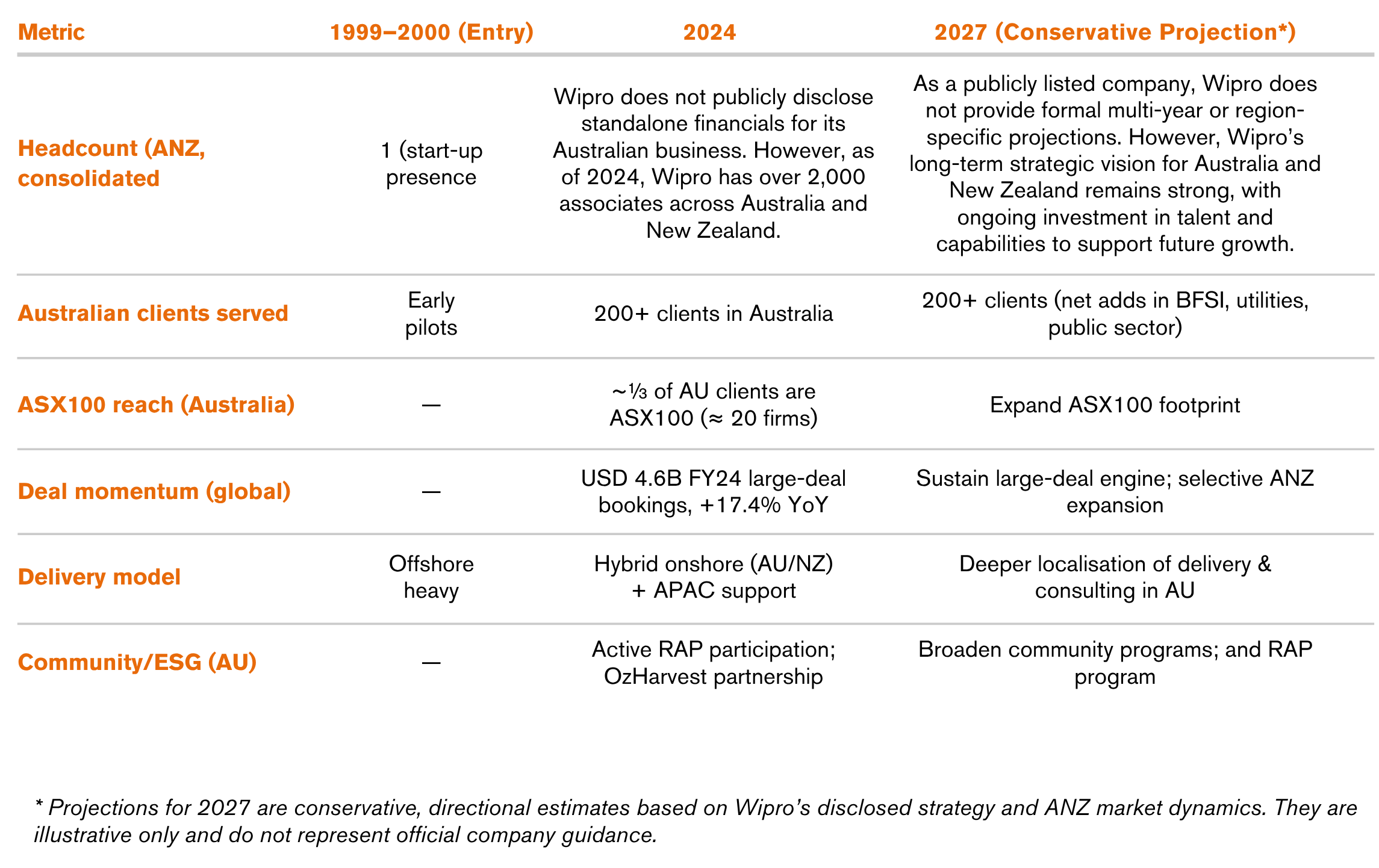
Wipro’s ANZ operations grew to ~2000 local employees in Australia, with a further 6,000 based in Asia Pacific supporting the region. Of those located in Australia, over 1000 are permanent residents or citizens. 27% of the Australian workforce are female, and 36% of the workforce across India and Australia serving the Australian business are female. These teams are supported by a network of development centers, digital labs and offices across Sydney, Melbourne, Perth, Brisbane, Canberra, ensuring proximity and rapid scalability for key clients.
This workforce infrastructure enabled Wipro to serve more than 60 Australian clients, including a third of the ASX 100 and major national banks, insurers, and telecoms. Innovation was central to execution; Wipro embedded AI, automation, cloud, and data analytics in its solutions, building on its global experience to help Australian clients modernise core IT and business processes[1]. The company’s edge in automation arose from its toolkits like Surfonomics (AI-powered multi-cloud optimisation) and Service Theatre (programmable service automation), and it incorporated ESG metrics into solution design and delivery, winning recognition in Australia for leadership in sustainability practices.
Execution was phased: first, sectoral focus in banking, telecom, and insurance; then, expansion to energy and government; finally, large-scale cross-industry digital transformation engagements as Wipro worked collaboratively with Australian clients to develop tailored delivery models that balanced local engagement with global expertise, ensuring high standards of service, security, and value.
Wipro’s “Triple-A” go-to-market playbook, leveraging relationships with advisors, analysts, and strategic technology alliances, established early credibility, enabled entry into large accounts, and drove organic growth without overextension. Organisationally, this was underpinned by the “Talent Engineering” framework, with leadership roles like Talent Engineering Heads and Skill Family Heads, ensuring best-fit talent supply and upskilling for emerging technologies.
Ecosystem enablers were crucial. Programs supported by Austrade, NASSCOM, and later the Australia-India ECTA streamlined talent mobility, improved local credibility, and de-risked long-term investment in R&D facilities, digital labs, and delivery centers. Wipro’s Australian journey exemplifies how a sectorally focused, advisor-driven, local-first, automation-anchored approach, scaffolded by industry and government partnerships, helped it go from a single-employee outpost in 1999 to a digital transformation partner for a third of the ASX 100 by the mid-2020s.
The idea was to play to our strengths and develop a highly relevant proposition.
- Simone Elliott, Head of Marketing, Wipro ANZ

Impact & Results
Wipro’s annual revenue for the year ended March 31, 2024, was US$10.8 billion globally, with the Australian subsidiary serving more than 60 clients including one-third of the ASX 100. In FY24, large deal bookings across Wipro rose to US$4.6 billion, up 17.4% year-on-year, reflecting significant contract wins and market confidence. Wipro demonstrated strong operational resilience, maintaining healthy margins and robust cash flows. These results reflect Wipro’s disciplined approach and ongoing investments in innovation and client value.
While Wipro does not publicly disclose standalone financials for its Australian business, Australia remains one of the company’s top ten global markets, with consistent growth and major contributions across key industry sectors. Australia is the largest market within Wipro’s Asia Pacific, India, Middle East and Africa (APMEA) Strategic Market Unit. Wipro's workforce in Australia surpassed 2,000 employees by 2024, with significant localisation, over 50% of its Australian workforce were nationals or permanent residents.
Gender diversity among new hires reached 35%, reflecting significant progress over previous years. Wipro is committed to further advancing diversity and inclusion, with ongoing initiatives to achieve even higher representation. The company prioritised upskilling, training, and “Talent Engineering” for digital, cloud, and automation roles, supporting both client outcomes and a more inclusive workforce.
In Australia, Wipro’s community initiatives, such as its partnership with OzHarvest and active participation in the Reconciliation Action Plan demonstrate its commitment to local social impact, complementing its global leadership in ESG and philanthropy.
"We firmly believe that AI is a transformative force that will augment human capabilities and pave the way forward for AI-first business models.
Wipro’s community initiatives through the Wipro Foundation impacted millions globally. It has reached over 4.92 million vulnerable children, and it pledged 67% of economic interest to social causes. On the ESG front, Wipro is committed to achieving net-zero emissions by 2040 and has integrated climate change action, water stewardship, and responsible supply chain management as core tenets. Its “double materiality” approach means both internal (reduced emissions, resilient infrastructure) and client-facing ESG projects (sustainable digital solutions, energy transition projects for Australian utilities).
Wipro’s strategic footprint in Australia not only consolidates its position as a regional hub for APAC digital transformation and innovation but provides a resilient template for global market replication through localisation, partnership, and sustainable business practices. The benchmark for success set by Wipro can be measured in enduring client relationships, diverse and future-ready talent, industry innovation partnerships, and quantifiable community and climate impact.

Lessons & Insights
Market Entry & Strategy
Wipro’s early entry into Australia highlighted the importance of local executive presence and networks for accelerating sales cycles and building client trust.
By empowering Australian leaders, establishing stable client teams, and engaging local advisors and analysts, Wipro strengthened its credibility and deepened client relationships.
Core Takeaway
In mature markets like Australia, accelerating market entry and building lasting client trust requires empowering local leadership and cultivating strong, locally embedded networks, an approach that has enabled Wipro to establish itself as a trusted transformation partner.
Regulatory & Policy Environment
Wipro has proactively engaged with Australian regulatory frameworks, ensuring full compliance with visa processes, employment standards, and investment approvals. The company’s constructive relationships with regulators have supported its sustainable growth in Australia.
Post-ECTA improvements reduced friction, easing skilled migration and recognition of global hiring standards.
Core Takeaway
While trade agreements facilitate talent mobility, sustained success in Australia depends on a proactive, robust compliance culture and constructive engagement with regulatory frameworks, areas where Wipro’s commitment to integrity and adaptability has set it apart.
Customer & Market Positioning
Wipro’s early experiences highlighted the importance of adapting to local market dynamics, leading to swift recalibration of pricing and talent retention strategies. These learnings enabled Wipro to strengthen its market fit and deliver greater value to Australian clients.
Wipro continuously refined its offerings based on close engagement with Australian clients, ensuring that new products and services were closely aligned with local buyer expectations and industry needs.
Core Takeaway
To win and retain clients in advanced markets, Wipro has demonstrated that true service excellence means tailoring not only technology, but also pricing, talent strategies, and engagement models to local expectations, delivering solutions that are both relevant and differentiated.
Organisation & Capability Building
Instituted post-mortems after failed launches, adjusted service delivery, and empowered local leadership to shape solutions.
Introduced cultural training and talent exchange and launched a Reconciliation Action Plan (RAP) to deepen community ties.
Core Takeaway
By embedding local leadership and fostering deep cultural understanding, Wipro has built a resilient organisation that consistently delivers long-term value and relevance to Australian clients, strengthening its position as a partner of choice.
Broader lesson for cross-border business
Wipro’s ongoing success in Australia is built on a foundation of delivery excellence, combined with a culture of continuous improvement, adaptability, and close collaboration with clients and partners.
Wipro’s strategy for enduring growth in Australia centres on proactive co-creation with partners, continuous market research, and deep cross-cultural engagement to deliver shared value.
Core Takeaway
In advanced economies, Wipro’s experience shows that genuine localisation is achieved when companies move beyond staffing to invest in community partnerships and co-create enduring value, building trust, reputation, and sustainable growth for all stakeholders.
All information has been verified from primary company submissions, official filings, interview transcripts, and secondary materials cited in the References section.
Company Snapshot

KPI Impact Snapshot