
How SolYield is Bridging the Solar Service Gap between India and Australia
Story of Data-Led Innovation, Circular Design, and Partner-Led Global Scaling

"Our platform doesn’t add another device; it turns every inverter into a smart sensor."
Context & Opportunity
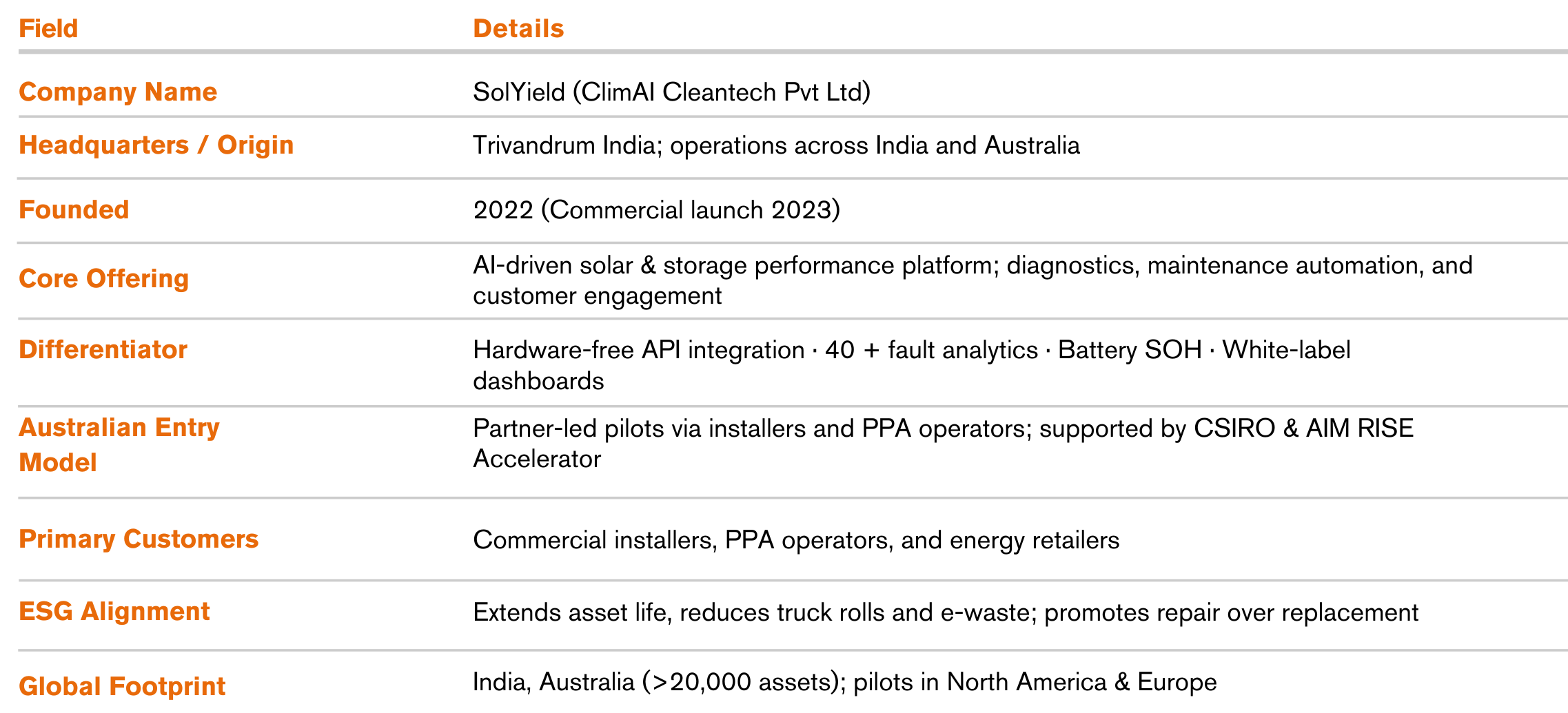
SolYield was founded to address one of the solar industry’s most persistent challenges, the absence of a unified, affordable, and intelligent digital layer to monitor, maintain, and optimise distributed solar and storage assets after installation.
SolYield was built by second-time founders with over 25 years of combined experience in energy analytics and the rooftop solar industry, who saw an opportunity to transform post-installation service from a cost centre into a profit engine. Their goal was simple: create a hardware-free, API-driven platform that turns inverter and battery data into actionable intelligence, without installing new sensors or devices.
The result is a SaaS platform that connects to all major inverter brands, analyses 40-plus solar and battery performance issues, and automates maintenance workflows. It provides installer-branded dashboards, automated reporting, and customer engagement tools, enabling solar businesses to cut operational costs, maximise solar savings, and strengthen customer referrals.
By 2025, SolYield monitored more than 20,000 assets across India and Australia, extending system life, cutting truck-rolls, and improving yield consistency for small and large installers alike. Its model advanced circular-economy goals, prioritising repair over replacement and positioned the company as a critical enabler of the net-zero transition: making clean energy not only greener, but smarter and more profitable.
Beyond performance monitoring, SolYield’s vision shaped out of the founders’ prior experience running solar-asset portfolios where post-installation service was the weakest commercial link. The team observed that over 18% of installed rooftop capacity in India was chronically underperforming due to poor after-sales service and fragmented O&M practices, leading to investor mistrust in small-scale solar. This insight shaped SolYield’s mission: to build the digital “aftermarket” backbone for solar, a platform where every kilowatt could be tracked, serviced, and optimised like an industrial asset. By removing the dependency on manual fault detection and fragmented technician networks, SolYield positioned itself as the digital layer connecting manufacturers, installers, and consumers in a circular, service-led solar economy.

Strategy & Execution
Australia was chosen deliberately as SolYield’s first international market. With four million rooftop systems, high labour costs, and growing curtailment challenges, it offered the perfect proving ground for the platform’s automation and analytics capabilities. The company entered through a partner-led, pilot-first strategy, collaborating with local installers and PPA operators rather than acquiring or incorporating immediately. Supported by CSIRO and Atal Innovation Mission’s Australia–India RISE Accelerator, SolYield ran pilots across 1000 sites in across Australia to fine-tune its algorithms for local grid conditions and multi-brand inverter portfolios.
The accelerator provided not only a grant but also legal, regulatory, and marketing mentorship, helping localise the product interface, messaging, and contractual frameworks. Customer feedback from these pilots directly shaped the platform’s evolution: dashboards were redesigned to emphasise battery State of Health (SOH) and curtailment-aware dispatch, while new API integrations solved regional compatibility bottlenecks.
Multiple pilot partners converted into paying enterprise clients including one of the Australia’s largest commercial-and-industrial solar developer validating product-market fit, with customer retention reaching 85%. The company continues to engage with partners to further align its offerings and internal policies with customer requirement, paving the way for future regulatory compliance and expansion.
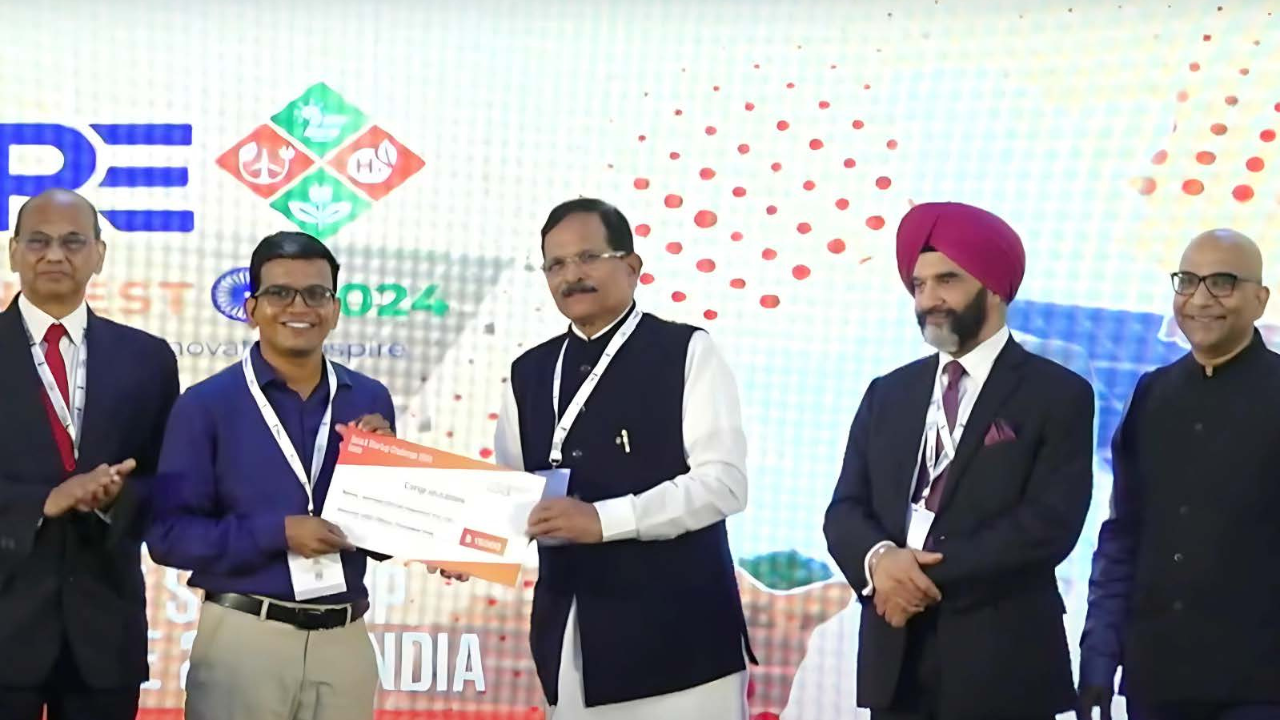
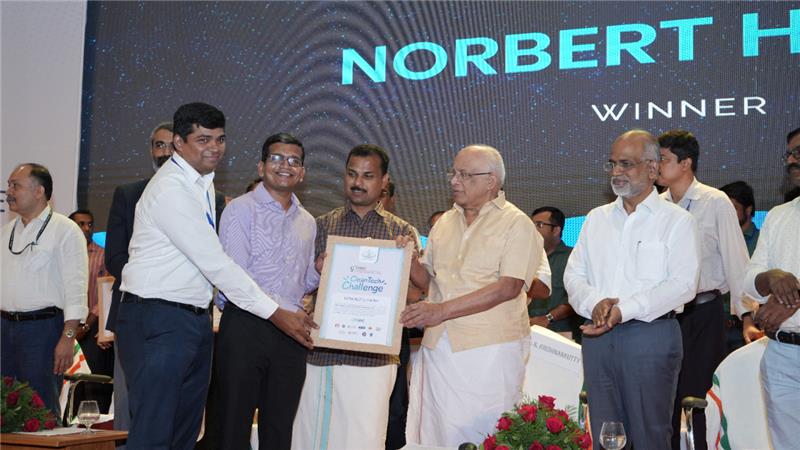
The company’s strategy extended beyond software localisation into ecosystem partnerships that would institutionalise its platform. SolYield participated in the SolarX Global Challenge where it was selected among the top 10 start-ups in India and is part of the SolarX Global Accelerator Program helping it expand to Africa and larger Asia Pacific Region. In India, they were selected as a part of one of the electron vibe programs by Climate Collective and is working with utilities in new energy transition use cases. These partnerships demonstrated SolYield’s ability to operate at both B2B and B2G levels, integrating into the broader digital energy ecosystem rather than functioning as a stand-alone SaaS vendor.
"Australia became our proving ground, the toughest service market for solar, and the perfect place to validate that data can solve what hardware cannot.
Impact & Results
SolYield’s dual-market model delivered measurable impact on both sides of the corridor. In India, its software-export business created high-value digital jobs in AI, ML, and energy analytics, with 90% of its engineering team based in India’s Tier-2 cities. The company now manages over 10,000 Indian sites, generating recurring revenue from installers, OEMs, and asset operators.
In Australia, the platform enabled installers to cut truck rolls, shorten service cycles, and raise plant yield. The pilot portfolio achieved a 40% pilot-to-paid conversion rate; the company’s diagnostic accuracy exceeded 95%, and automated workflows reduced maintenance overheads by more than 30%. Australia now contributes over 60% of SolYield’s monthly recurring revenue, and enterprise customers have reported improved asset performance and customer retention.
SolYield’s experience in Australia also shaped its global roadmap. Lessons from operating in one of the world’s most digitally mature solar markets, API standardisation, curtailment management, and data-privacy compliance have been codified into a replicable localisation playbook for expansion into North America and Europe. The company continues to demonstrate that clean-tech SaaS built in India can scale globally without hardware, inventory, or heavy capital expenditure turning digital capability into climate impact.
"For us, success was not in building faster, it was in building trust through every pilot before asking for a contract.
SolYield’s results were not only commercial but also systemic. The firm’s analytics identified over 200GWh of recoverable generation annually across monitored systems. On the sustainability front, SolYield estimated that automated fault response and reduced truck-rolls cut around 120,000 metric tonnes of CO₂ emissions annually across its pilot fleet, showing how digitalisation directly reduces operational emissions in renewables. These outcomes reinforced the company’s credibility with both investors and regulators seeking quantifiable climate impact.
Lessons & Insights
SolYield’s trajectory underscores that pilot-led trust-building can outperform capital-heavy market entry when launching in advanced economies. Local partners validated the technology faster and at lower risk than a subsidiary-first model would have allowed. Second, rapid localisation from user-interface language to battery analytics proved essential for adoption in a market that values precision and autonomy. Third, Australia showed that regulatory alignment is not a barrier but a differentiator: by complying early with data privacy regulations, SolYield earned credibility with enterprise buyers. Finally, data discipline over marketing spend was decisive: every KPI from pilot-conversion rate (40%) to NPS was tracked, analysed, and fed back into the product loop.
Core Takeaway
Scalable internationalisation in clean tech is not about size, it’s about precision, partnerships, and proof.
An important lesson from SolYield’s journey is that data transparency itself became a competitive differentiator. Many installers were initially reluctant to share inverter data, fearing exposure of underperformance. By creating data-sharing agreements compliant with both India’s and Australia’s regulations, SolYield built a trust architecture that encouraged participation. This not only protected end-users but also created a verifiable audit trail of generation, empowering installers to monetise service reliability as a premium feature. The experience underscored that policy alignment and privacy compliance are not paperwork, they are market enablers in the age of digital energy.
All information has been verified from primary company submissions, official filings, interview transcripts, and secondary materials cited in the References section.
Company Snapshot