
How the RISE Accelerator is Scaling Australia’s Next Generation of Ventures for Global Impact
Story of Collaboration, Scale, and Entrepreneurship
"RISE supports (startups) with high potential, but limited reach. It is designed to champion the underdogs with bold ideas, giving them the platform, support, and access they need to become the next generation of global leaders."
Context & Opportunities
Launched in 2023, the India Australia Rapid Innovation and Startup Expansion (RISE) Accelerator is a joint initiative of India’s Atal Innovation Mission (NITI Aayog) and Australia’s national science agency, CSIRO. Conceived under the updated India Economic Strategy to 2035 Report (in 2022), the program reflects a shared commitment to mobilise complementary capabilities against global sustainability challenges.
RISE is a distinct model of bilateral cooperation, tailored to the realities of start-ups and SMEs. Unlike multinationals, these firms often lack the resources to deploy global teams or establish operations independently. RISE bridges that gap, offering targeted support as they expand into new markets.
The program is grounded in the net-zero ambitions of both countries (2050 for Australia, 2070 for India) and the urgency to accelerate the scaling and adoption of innovative climate and environmental technologies. Over the course of the program, it equips participants with practical insights into market dynamics, cultural context, and regulatory frameworks, while providing structured opportunities to pilot and adapt their solutions.
Beyond knowledge transfer, RISE accelerates access to customers, investors, and industry partners, connections that would otherwise be out of reach. By lowering entry barriers and enabling cross-border collaboration, it positions high-potential innovators to scale and lead in addressing some of the world’s most pressing challenges.
Strategy & Execution
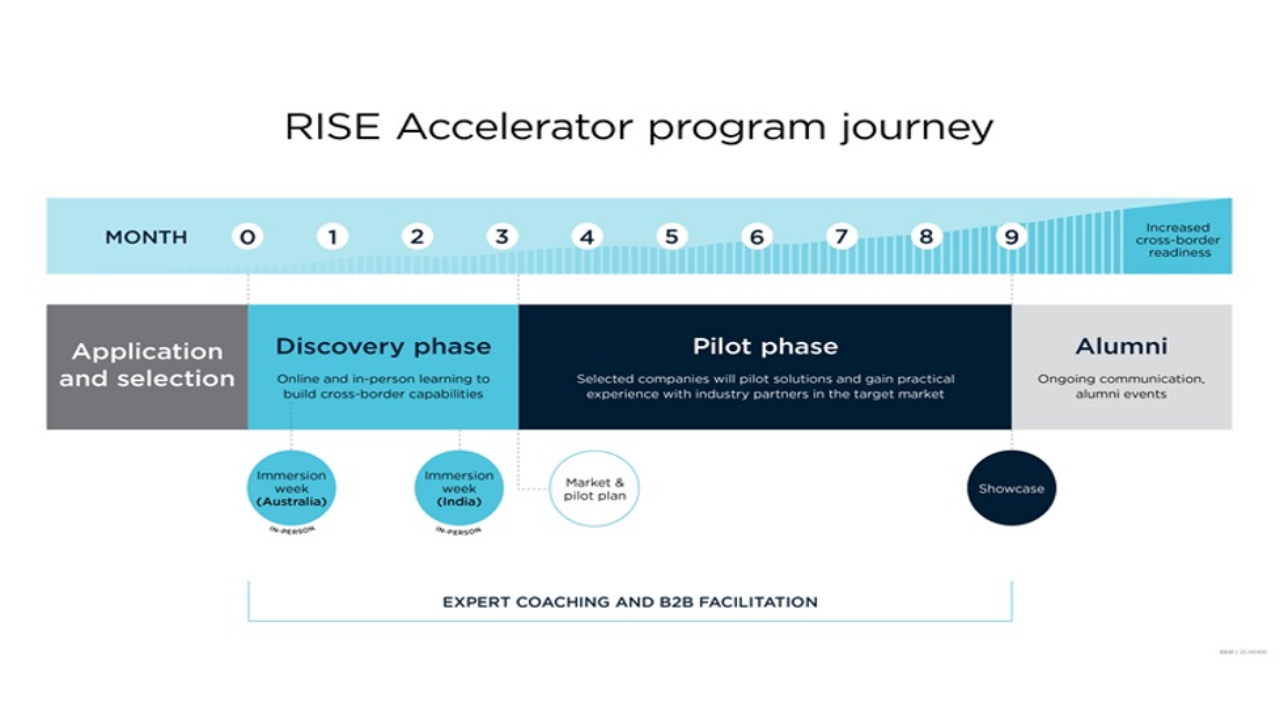
CSIRO and the Atal Innovation Mission (AIM) co-designed RISE as a purpose-built accelerator for start-ups and SMEs with high potential climate technology solutions. Each cohort is deliberately small (10–20 firms from India and/or Australia) and organised around priority themes such as circular economy, climate-smart agriculture, and renewable energy. The program follows a two-phase structure designed to move start-ups from market discovery to pilot execution.
- Discovery Phase: Sprint-style learning on cross-border trade, technology adaptation, and market readiness. This is reinforced by mentoring from experts-in-residence, curated introductions to industry leaders, immersive visits, and investor exposure.
- Pilot Phase: Translation of plans into action through co-designed pilots, market research, and R&D collaborations. Selected firms receive government grants to underwrite expansion (e.g. Round 3 start-ups can access $35K in seed support and up to $100K for pilots).
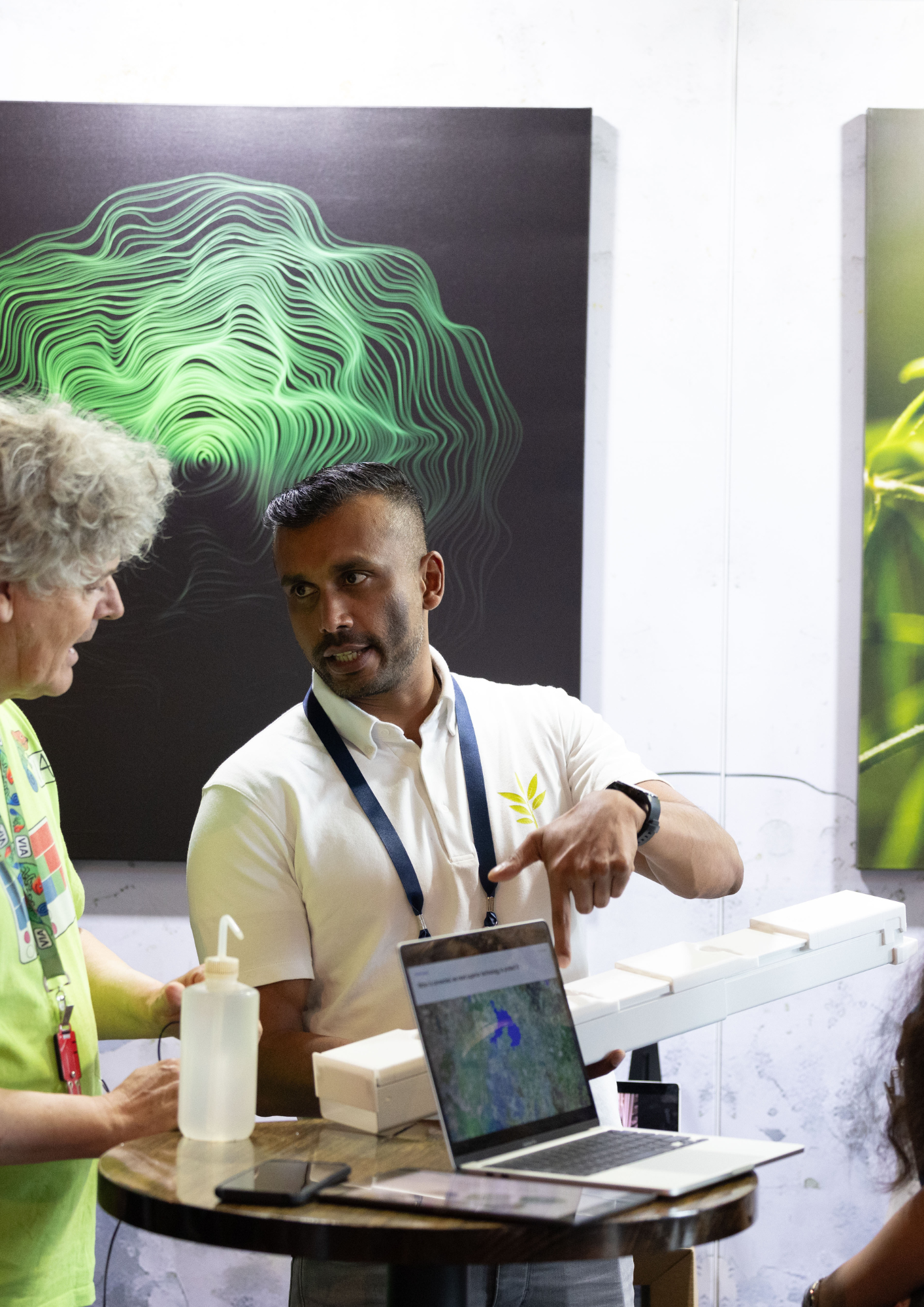
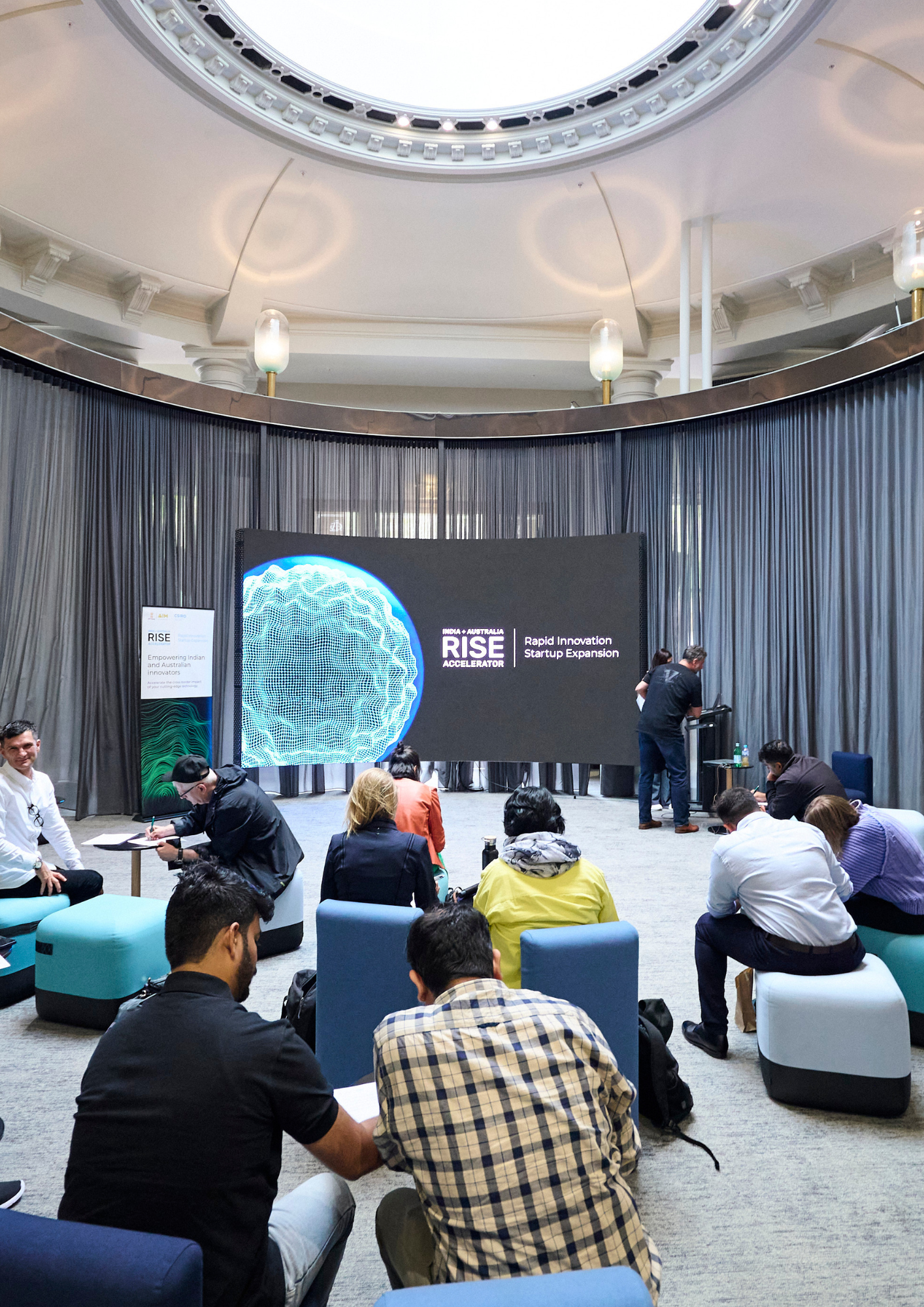
RISE’s differentiator is bilateral immersion. Participants spend one week in India and one week in Australia, visiting manufacturers, start-ups, and research centres. This hands-on engagement bridges knowledge gaps that desktop research cannot. As Alt. Leather’s founder noted after visiting Indian manufacturers, “No amount of desktop research could provide that.”
Dedicated in-country support further amplifies outcomes. Experienced facilitators and experts-in-residence work closely with each start-up, identifying opportunities and risks early and adapting solutions to local conditions. Newera Bio’s co-founder and CEO highlighted the value of refining their proposition before RISE Immersion Week, enabling sharper engagement with Indian stakeholders.
The program also leverages existing ecosystems. AIM’s network of approximately 70 Atal Incubation Centres connects participants to local partners, with one Australian start-up linked to an Indian textile incubator for pilot trials, while another was linked to a coffee research institute and incubator.
RISE itself embodies the incremental approach it recommends to start-ups, with broad market analysis and validation, with a narrowing of focus to identify appropriate opportunities within associated value chains.approach it recommends to start-ups. Originating as a low-cost COVID hackathon, it has evolved into a collaborative accelerator program now serving as a blueprint for bilateral cooperation and commercialisation. This playbook, enter cautiously, build trust, then scale, has become RISE’s distinctive contribution to cross-border start-up acceleration.
"No amount of desktop research could provide that, and it would be difficult to cold-call a manufacturer yourself to get a visit like that secured. RISE’s network opens the doors to trusted parties.
Impact & Results
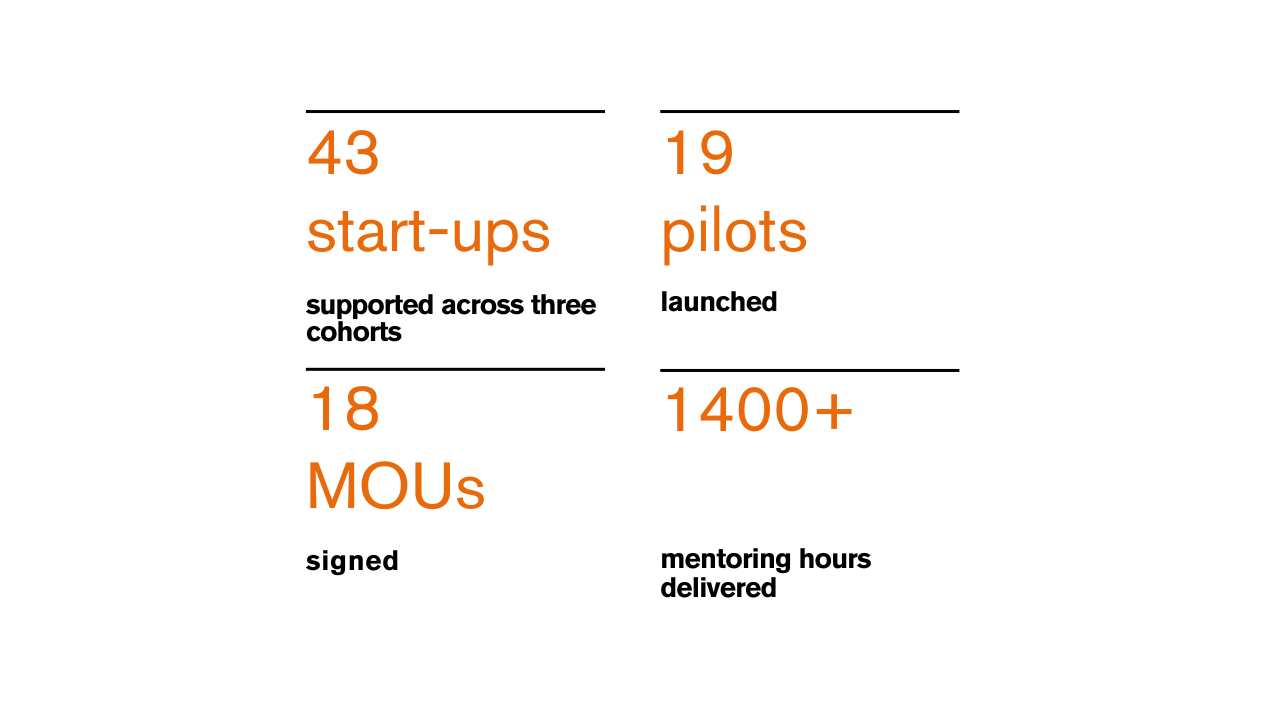
Launched in 2023, the RISE accelerator program has become a pivotal platform for start-ups and SMEs to validate, adapt, and pilot technologies across India and Australia. Designed to align with shared strategic priorities, the program has advanced innovation themes ranging from the circular economy to renewable energy.
Round 1 focused on the circular economy and consisted of 14 start-ups and SMEs. The cohort delivered:
- 712 hours of one-on-one mentoring
- 47 training sessions
- 11 cross-border MoUs
- 12 pilots and projects launched
- 2 immersion weeks and 32 cross-border trips
Round 2 shifted to climate-smart agriculture and supported 10 start-ups and SMEs to adapt technologies to Indian and Australian markets, delivering:
- 700 hours of one-on-one mentoring
- 35 training sessions
- 7 cross-border MoUs
- 7 pilots and projects launched
- 2 immersion weeks and 21 cross-border trips
Round 3 expanded to renewable energy, with 19 Australian start-ups, each receiving A$35,000 in seed grants and eligible for A$100,000 in pilot funding.
The program has already produced notable success stories:
- Alt. Leather (Australia): Piloted 100% bio-based leather in India, producing handbags and footwear with local manufacturers and scaling to industrial levels.
- Caliche (India): Adapted its CarbonOne bioreactors to global markets, capturing ~85% of CO₂ from flue gas and deploying units in India, Australia, and the UAE.
- SORR & Circular Seed (Australia): Formed a cross-border collaboration during RISE Immersion Weeks, combining oil-spill remediation and plastic recycling technologies in a joint project in Goa.
A defining strength of RISE has been its flexibility and responsiveness. Themes have been tailored to evolving sectoral needs (circular economy, climate-smart agriculture, renewable energy), with funding support to aid target market understanding and technology pilot/demonstrations.
With India and Australia progressing toward a Comprehensive Economic Cooperation Agreement (CECA), RISE is well-positioned to serve as a cornerstone of bilateral innovation, deepening cross-border trade, investment, and climate-tech collaboration while expanding into new strategic sectors.
"The nuances of doing business in a new place take time to see and understand. For Australian companies grappling with the scale of the India market takes careful consideration; for Indian companies the reticence of some sectors to assess new, international partners takes resilience and perseverance to break through.
Lessons & Insights
Market Entry & Strategy
Entering new markets requires time, cultural adaptation, and trust-building.
RISE’s bilateral cohort model (with both Australian and Indian start-ups, experts-in-residence and program facilitators) reduced cultural barriers and fostered peer-level collaboration.
Example: SORR and Circular Seed met during a RISE immersion and began planning a joint project in India.
Core Takeaway
Structuring accelerators as bilateral platforms accelerates trust and creates concrete cross-border ventures.
Government and ecosystem leverage
RISE embedded pilots with in-country partners as a benchmark for success, not just pitch decks.
Start-ups gained credibility through MoUs, test projects, and regulatory learning.
Core Takeaway
Tangible pilots de-risk market entry and build early credibility in unfamiliar ecosystems.
Networks & Relationship Building
Success often depended on local customers, distributors, suppliers, and research partners.
RISE brokered introductions and created structured opportunities for engagement.
Core Takeaway
In new markets, curated networks act as strategic enablers of growth and trust.
Public–Private Ecosystem Support
The CSIRO–AIM partnership gave RISE participants leverage far beyond what start-ups could achieve alone.
Example: AIM linked Newera Bio to NIFT-TEA, enabling pilots in natural dyes that would have been difficult independently.
Core Takeaway
Government–science partnerships can amplify start-ups’ reach, credibility, and access to scale.
Broader lesson for cross-border business
RISE illustrates that international expansion is not simply exporting products—it is about validating market fit, adapting to local nuance, and leveraging ecosystem scaffolding.
Bilateral frameworks (AIM incubators, CSIRO credibility, ECTA/CECA policy support) provide the structural conditions for scale.
Core Takeaway
Success abroad requires the right mix of patience, pilots, partnerships, and policy alignment.
All information has been verified from primary company submissions, official filings, interview transcripts, and secondary materials cited in the References section.