How New Era Bio is Transforming India’s Textile Dyeing Industry with Sustainable Bio-Dye Solutions
Story of Innovation, Market Entry, and Green Manufacturing

"We plan to be selling our dyes to major textile mills in India within 2–3 years , hiring on-site sales and technical staff to ensure we provide the best service possible."
Context & Opportunity
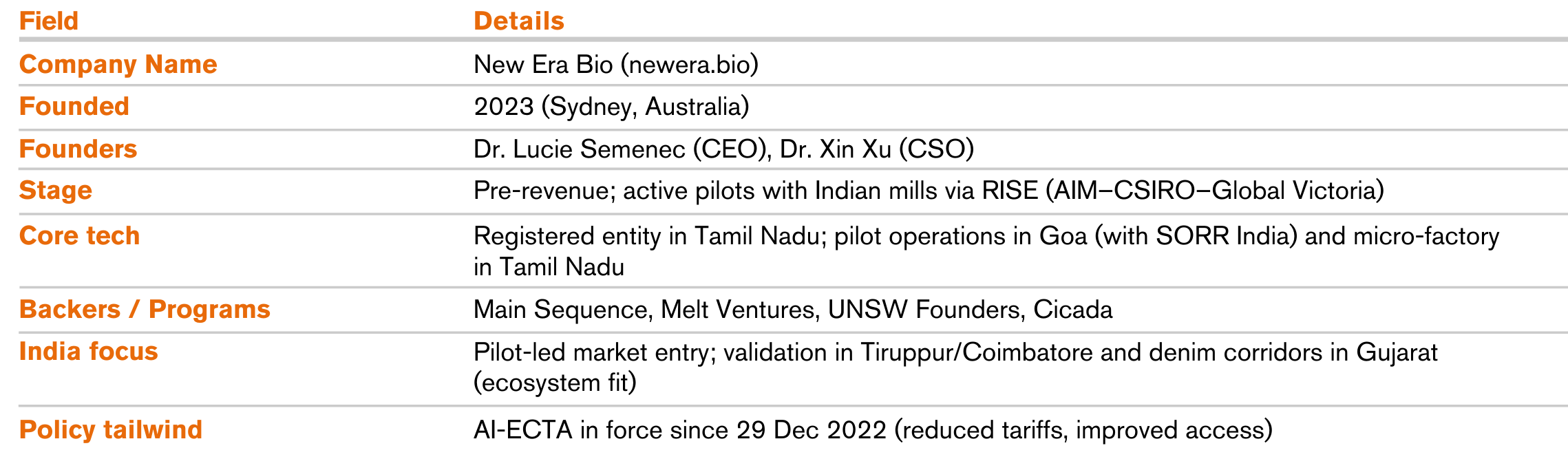
New Era Bio was founded in June 2023 out of pioneering research at Macquarie University’s ARC Centre of Excellence in Synthetic Biology. During US Army–funded work on plastic-degrading microbes, founders Drs. Lucie Semenec and Xin Xu identified the potential of microbial pigments as high-performance bio-based dyes. Backed by Main Sequence Ventures, the company set out to solve a long-standing challenge in the US$2.5 trillion global textile industry: sustainable dyes have consistently underperformed against fossil fuel–derived alternatives, leaving mills with few viable options to decarbonise.
The market timing proved decisive. India, the world’s second-largest textile dyer, is under growing sustainability and regulatory pressure but has resisted bio-based solutions due to poor performance which leads to longer dyeing times and higher energy use and increased overall cost. The stakes are significant: 90% of global textile dyes are fossil fuel–based, and dyeing is responsible for 20% of global water pollution. This created a structural market gap, sustainable alternatives were environmentally compelling but commercially impractical. New Era Bio’s patent-binding technology offered a breakthrough by delivering both performance and sustainability, unlocking the potential for large-scale adoption.
The Australia–India corridor became central to the company’s growth model after the Australia–India Economic Cooperation and Trade Agreement (AI-ECTA) took effect in December 2022, providing preferential access for clean technology solutions.
The alignment was natural: Australia contributes world-class synthetic biology research, while India brings manufacturing scale and cost competitiveness in textile hubs such as Coimbatore’s dyeing clusters and Gujarat’s denim facilities. Together, the corridor offers the foundation for rapid technology validation and deployment at commercial scale.
Rather than positioning itself as a direct competitor to dye manufacturers, New Era Bio has framed itself as an enabling technology platform for system-wide transformation. Its business model centres on three-way partnerships between textile mills, retail brands, and its binding technology, creating a collaborative pathway to decarbonise dyeing without forcing mills to absorb unsustainable costs. Early pilots are designed to validate performance in India’s demanding operating environment before scaling into full commercial deployment.
New Era Bio represents a potential inflection point for the textile value chain. By combining Australia’s synthetic biology capabilities with India’s manufacturing ecosystems, the company is positioned to accelerate the shift from fossil-based to bio-based dyes. If successful, its model could catalyse not only commercial adoption but also a broader reconfiguration of global dyeing standards making sustainability a competitive advantage rather than a compliance burden.

Strategy & Execution
Partner-led Entry Strategy
New Era Bio adopted a partner-led entry strategy in India, deliberately avoiding capital-intensive greenfield or joint venture models at its pre-revenue stage. This choice prioritised capital efficiency, rapid market validation, and learning-by-doing. By collaborating directly with textile mills, the company was able to test its patented bio-based dye technology under industrial conditions without significant upfront investment. A partnership with Cotton Blossom Mill in Tamil Nadu proved pivotal, with operational insights from the general manager informing both product development and adaptation to local market needs. Rather than establishing a physical presence, New Era Bio relied on industrial liaisons and advisors to navigate distribution networks and foster client relationships in its early growth phase.
The localisation approach was structured around a tri-party partnership framework, linking retail apparel brands, textile mills, and the company’s binding technology platform. Strategic alliances with NIFT-TEA, Cotton Blossom Mills, and Mayavan Botanicas in Coimbatore, India’s textile dyeing hub, established credibility through joint testing and validation. Parallel discussions with denim mills in Gujarat are extending this model into other high-volume clusters. By embedding itself in the existing value chain, New Era Bio built trust and legitimacy while maintaining a lean operating model.
Talent acquisition mirrored this capital-light approach. The company leveraged LinkedIn and Sales Navigator to recruit three Indian industry liaisons on a contract basis, achieving higher engagement than traditional job portals while avoiding permanent local overhead.
Business interactions and pilot coordination were managed through WhatsApp-based group communication, complemented by weekly structured meetings. This hybrid communication model aligned with Indian business norms, accelerated response times, and ensured continuity across pilot projects.
At the core of execution lies New Era Bio’s patented binding technology, which overcomes the performance barriers that have historically limited bio-based dyes. Unlike plant-derived dyes that require elevated temperatures, metal mordants, and extended processing cycles, New Era Bio’s solution delivers fossil fuel–equivalent performance while reducing energy, water, and chemical intensity. Pricing is benchmarked against plant-based alternatives, ensuring competitiveness for Indian mills. The result is a biodegradable, non-toxic dyeing solution that enhances workplace safety, reduces water pollution, and eliminates the environmental trade-offs that have long plagued sustainable dyeing.
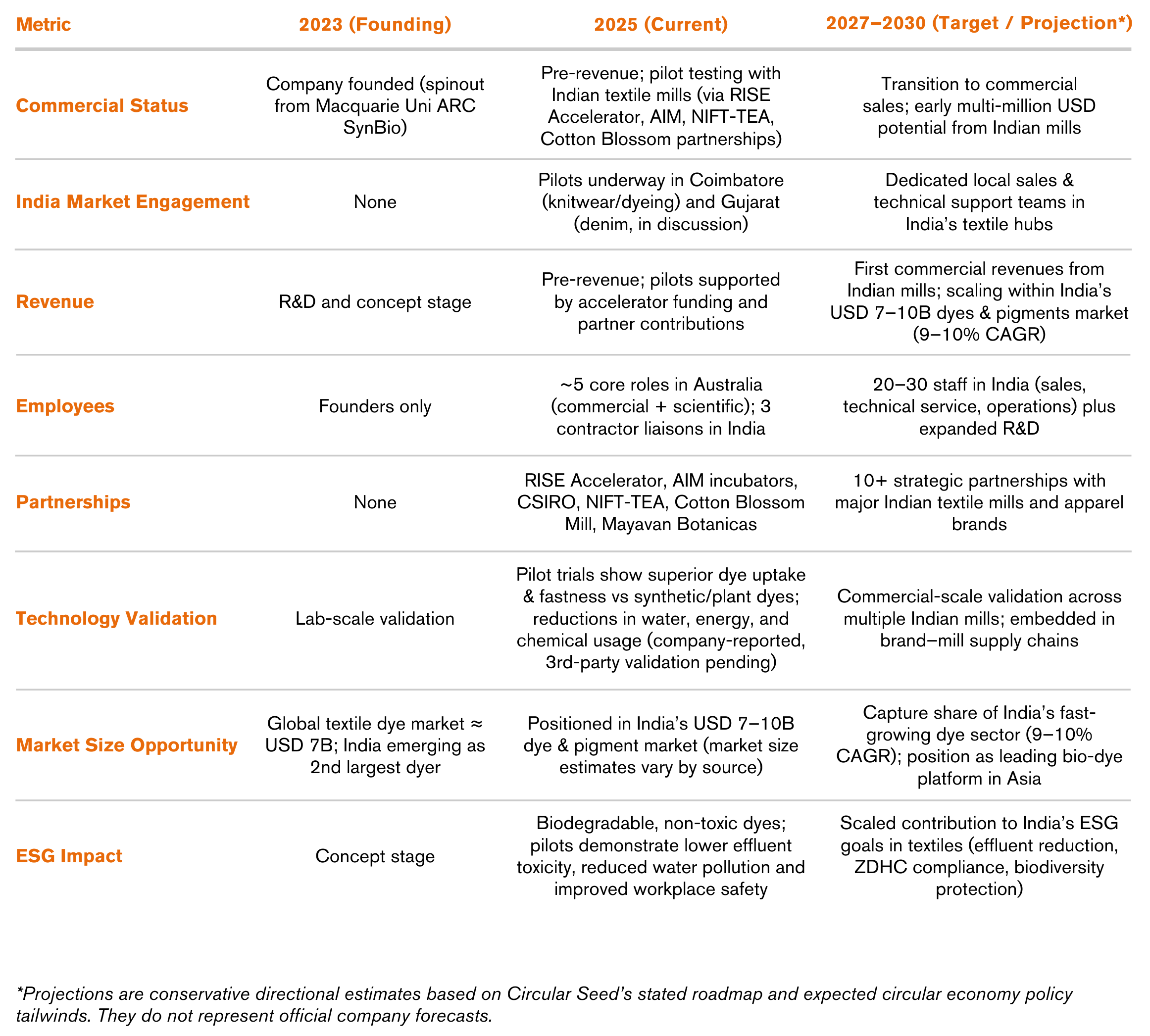
The company’s growth path is sequenced across three phases. Phase 1 focuses on pilot testing with Indian mills, validating product–market fit and operational feasibility. Phase 2, expected within one to two years, will involve commercial sales of proven formulations. Phase 3, over three to five years, targets full market penetration through a dedicated local salesforce and technical support infrastructure. Pilot evaluations assess dye uptake, fastness, consistency, and infrastructure compatibility, with mill technical directors providing feedback on operational ease and commercial readiness.
Organisationally, New Era Bio is structured to balance scientific innovation with commercial execution. Co-founders serve as CEO and CSO, supported by a Chief Commercial Officer driving partnerships, a Sustainability and Brand Officer leading ESG integration, and technical specialists in metabolic engineering and organic chemistry. This configuration ensures alignment between breakthrough science, market engagement, and sustainability commitments.
Digital tools reinforce this lean execution model. Shared drives house pilot results, research insights, and strategy materials, while LinkedIn serves as the primary B2B marketing channel, positioning the company as a thought leader in bio-based dyes. Educational content and updates have achieved engagement levels comparable to established players, strengthening credibility with mills and brands alike.

"Our technology improves the binding of bio-based dyes to textiles, reducing the energy, time and chemicals needed while delivering the performance mills demand."
Impact & Results
Although still in the pre-revenue stage, New Era Bio has already generated tangible impact across talent, operations, and ESG during its expansion into India.
On the talent front, the company has created five new roles in Australia across commercial and scientific functions while engaging three industrial liaisons in India on a contract basis. This cross-border model illustrates how early-stage ventures can build international capabilities and market insight without incurring heavy fixed overheads.
Operationally, the pilot testing program has produced quantifiable performance improvements that validate the technology’s market potential. Trials have demonstrated superior microbial dye uptake and fastness relative to both synthetic and plant-based benchmarks, all while remaining compatible with existing mill infrastructure requiring no costly process modifications. Crucially, pilots show material reductions in water, energy, and chemical use, directly addressing the textile industry’s most pressing sustainability challenges.
From an ESG perspective, New Era Bio’s biodegradable and non-toxic dyeing solutions directly confront an industry responsible for 20% of global water pollution, while reducing reliance on the 90% fossil fuel dominated dye market. The technology enhances worker safety, reduces biodiversity damage, and sets new standards that combine environmental integrity with operational efficiency.
The company’s tri-party partnership framework, linking textile mills, apparel brands, and its binding technology platform, has extended its footprint beyond conventional market measures. Its digital engagement strategy on LinkedIn now delivers post interactions on par with established bio-based dye competitors, strengthening thought leadership and brand recognition in an emerging sector.
The broader lesson lies in New Era Bio’s validation-first model. By prioritising product–market fit and performance parity with incumbent solutions before pursuing revenue, the company has created a replicable framework for technology ventures entering entrenched industrial sectors. This approach demonstrates that sustainability and performance need not be trade-offs but can converge to unlock sector-wide transformation.
"The greatest way to solidify partnerships in India is to visit mills in person, sit down for a meal, and build trust beyond transactions.

Lessons & Insights
Market Entry & Strategy
Differences in communication rhythms between Australia and India slowed collaboration and created gaps in project momentum.
Establishing flexible meeting schedules, using alternative channels, and creating regular touchpoints became essential.
Core Takeaway
Cultural adaptation in communication rhythms is critical to maintaining momentum across geographies.
Operational Execution & Collaboration
Geographical distance complicated real-time communication with Indian textile mills.
Strategic pivots included WhatsApp groups for instant messaging and weekly meeting schedules to ensure consistent engagement.
Core Takeaway
Embedding structured communication protocols safeguards cross-border projects from losing traction.
Relationship Building & Trust
Personal relationships, in-person visits, and informal engagements (such as meals) proved decisive in building trust with Indian partners.
Core Takeaway
In India, partnership foundations are strengthened through human connection, not just virtual or transactional engagement.
Risk Management & IP Protection
Early-stage operations highlighted the need to balance transparency with intellectual property protection.
Stakeholders were required to sign NDAs and material transfer agreements during technology sharing.
Core Takeaway
Protecting IP while building trust requires carefully designed agreements and staged disclosure during pilots.
Organisational Learning & Adaptability
Limited internal complexity simplified alignment, but the company had to remain agile in balancing speed with caution in pilot testing.
Core Takeaway
Start-ups entering new markets must combine lean decision-making with disciplined risk protocols to sustain credibility.
Broader Lesson for Cross-Border Business
Distance and cultural differences can easily derail collaboration without deliberate strategies.
In-person engagement, structured communication rhythms, and balanced IP protection are the foundation for scaling.
Core Takeaway
Successful cross-border innovation in India requires sustained communication discipline, trust-building, and phased risk management.

All information has been verified from primary company submissions, official filings, interview transcripts, and secondary materials cited in the References section.
Company Snapshot
KPI Impact Snapshot