How Energy Exemplar Expanded into India’s Energy Transition Market
Story of Strategy, Localisation, and Technology-Driven Impact

"Our mission is Empowering Transformative Energy Decisions. We do this by enabling smarter, faster, and more sustainable planning and operations."
Context & Opportunity
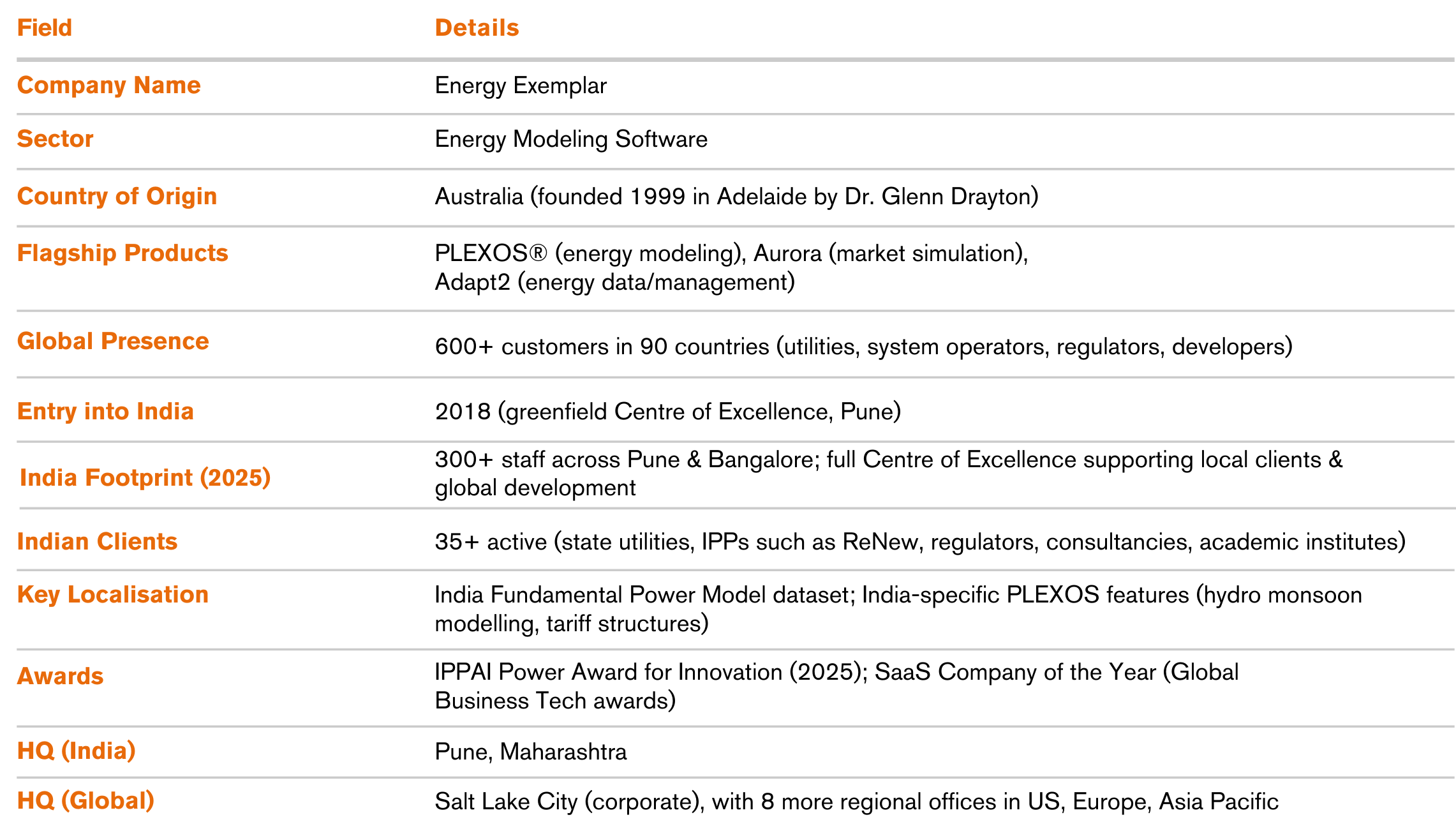
Founded in Adelaide in 1999 by Dr Glenn Drayton, Energy Exemplar is an Australian-origin energy software company that develops advanced market-simulation platforms such as PLEXOS®, alongside complementary tools Aurora (market forecasting) and Adapt2 (energy management). Over two decades, the company has become a global category leader, serving 600+ clients across 90 countries, helping utilities, generators, and regulators run cleaner, more efficient grids. Its software is recognised as a “powerful energy-market simulation engine,” used to optimise investment and operations across electricity, gas and water systems.
Meanwhile, India’s power sector stands at a historic inflection point. The government’s target of 500 GW of renewable capacity by 2030, representing roughly half of total generation, demands unprecedented levels of grid planning, flexibility, and digital foresight. The International Energy Agency notes that achieving this will require sophisticated modelling of generation mixes, transmission upgrades, and storage integration. India is at a strategic inflexion point requiring exactly the kind of modelling solutions Energy Exemplar provides.
Simultaneously, ties between Australia and India have been strengthening. The Australia–India Economic Cooperation and Trade Agreement (AI-ECTA) came into effect in late 2022, providing tariff concessions and market access that benefit Australian exporters in services and technology. For Energy Exemplar, India presented both a significant market opportunity and a cost-effective talent pool. India’s ambitious clean-energy agenda, together with Australia–India cooperation frameworks, made the timing ideal for Energy Exemplar’s entry.
Energy Exemplar’s India entry was therefore designed not merely as market expansion, but as capability creation, positioning India as a regional base for energy-transition expertise and a global Centre of Excellence. This approach integrates commercial growth with strategic localisation: serving India’s grid-modernisation priorities while strengthening the company’s global innovation engine.

Strategy & Execution

Greenfield entry strategy
Energy Exemplar adopted a direct greenfield strategy to enter India, prioritising full control, cultural alignment, and capability development over partnerships or acquisitions. In 2018, it opened its first office in Pune, Maharashtra, establishing a Centre of Excellence (CoE) built from the ground up to harness India’s deep engineering talent and proximity to the fast-evolving energy market.
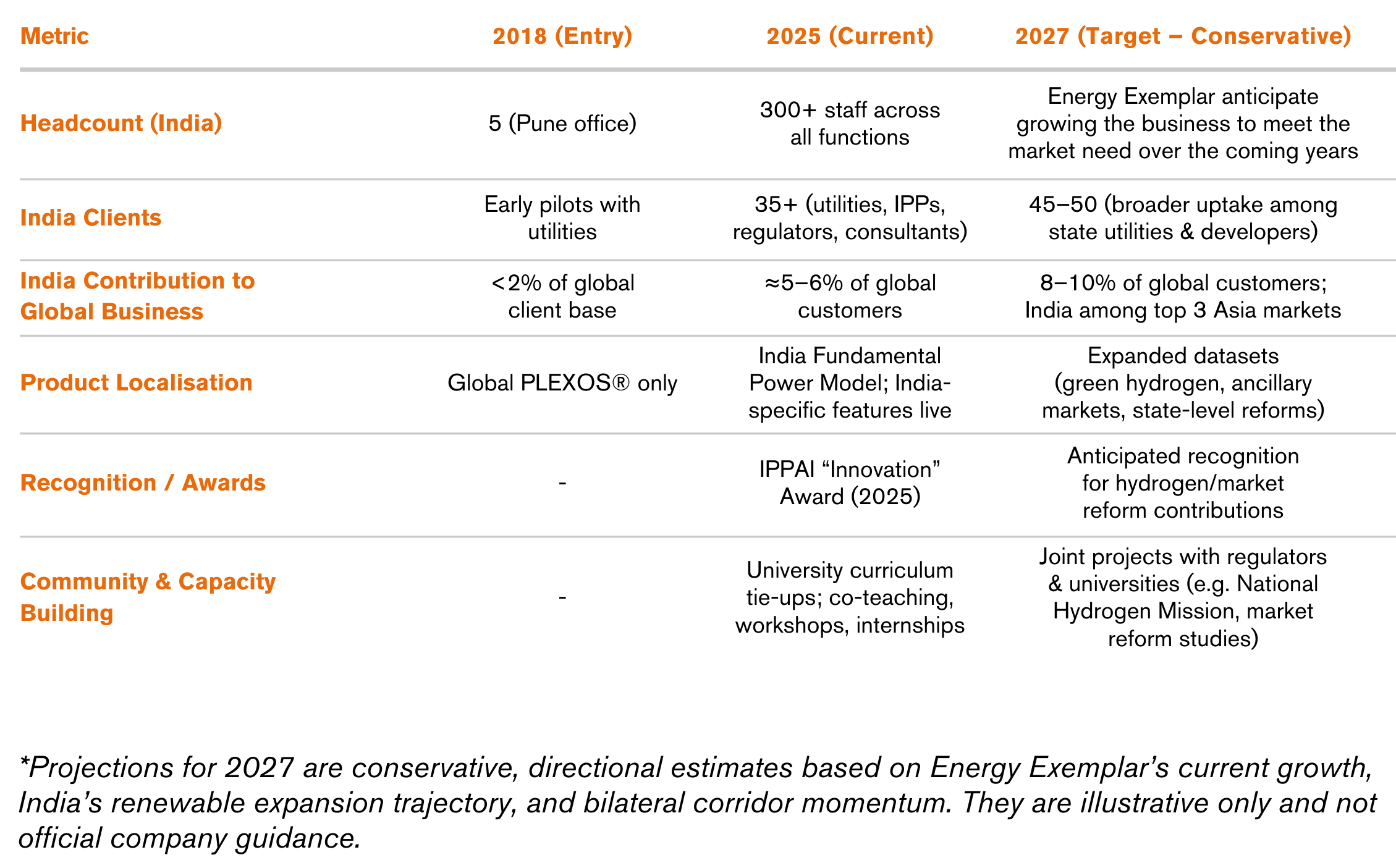
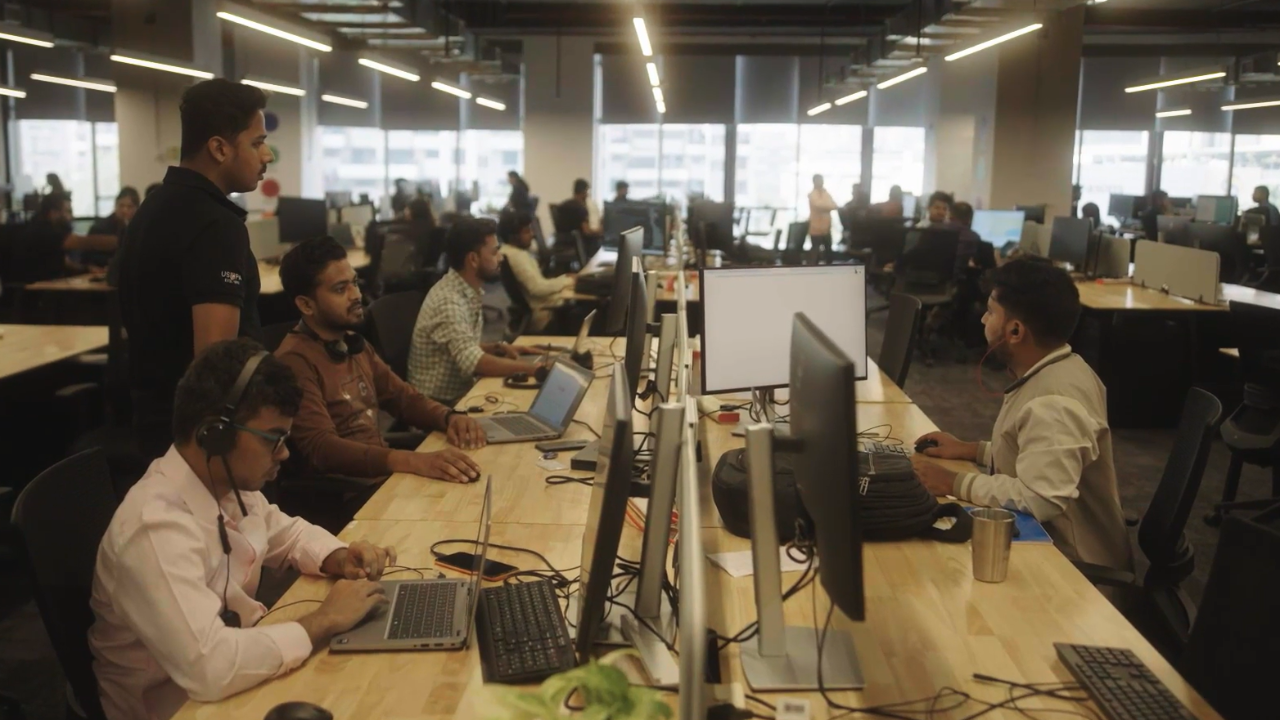
By 2020, a second facility followed, and the Pune operation rapidly scaled into a full India CoE supporting both domestic clients and global software development. Early investment in people proved decisive: the India team grew from five employees in 2018 to more than 300 by 2025, spanning engineers, analysts, and trainers across Pune and Bengaluru.
Rather than outsourcing or relying on contractors, Energy Exemplar hired and developed talent locally, launching structured programs for training, onboarding, and mentoring to build in-house expertise in PLEXOS® and related platforms. An India-based leadership team was appointed to oversee hiring, training and delivery, supported by global software specialists, ensuring strong integration between local execution and global standards.
Today, Energy Exemplar’s India Centre of Excellence serves as both a delivery powerhouse and an innovation hub, where local engineers use PLEXOS® to help global clients optimise their energy futures and accelerate the world’s clean-energy transition.
"India’s energy goals are both ambitious and urgent… That opened the door for Energy Exemplar to not just provide software but also partner on upskilling and strategy.
The execution strategy followed a deliberate sequence. Talent first: the company hired core teams of energymodellers and software engineers, providing intensive training in PLEXOS, Aurora and Adapt2. Local engagement: with the team in place, they then focused on building relationships. Staff regularly meet with state utilities, power producers and regulators – as one account notes, “staff members engage with a range of stakeholders… including energy producers, distribution utilities, regulators, planning bodies and consultants”. Energy Exemplar also took part in industry conferences and government roundtables (often with Austrade’s help) to showcase its technology. Product adaptation: next, the company customised its offerings for India. Engineers developed an “India Fundamental Power Model”, an India-specific simulation dataset now offered to clients. They also localised the software: for example, PLEXOS models were tuned to Indian grid characteristics, and user interfaces and documentation were made India-specific. Contextual training programs were rolled out for Indian engineers and students to build a skilled user base.
Digital innovation was central throughout. Energy Exemplar leveraged the cloud to enable clients to run complex scenarios from anywhere. PLEXOS’s advanced AI-driven solvers enabled the India team to handle massive renewable-integration studies. For instance, to help state planners decide where to install new solar farms, the Pune team ran Monte Carlo simulations of solar/wind output versus demand. These tools let clients optimise generation portfolios and storage investments for 2030 scenarios. Academics and consultants were also engaged: the company collaborated with Indian universities to incorporate grid data and to co-teach energy modelling.
Through strategic ecosystem engagement, Energy Exemplar built strong relationships across government, academia, and industry, linking its Pune team with utilities, regulators, and policymakers to deepen market understanding. Support from Austrade and other bilateral partners helped accelerate these connections, providing early market intelligence and stakeholder access during the company’sexpansionphase.
In summary, Energy Exemplar’s India strategy followed a disciplined, three-phase execution model: build talent, embed locally, and adapt product.
By first investing in a high-calibre local team, then integrating that team within India’s energy ecosystem, and finally tailoring its software to national market requirements, the company created a scalable and sustainable foundation for growth. This sequential approach ensured that each phase reinforced the next, linking capability building with market insight and product relevance.

Impact & Results
The expansion quickly delivered results. By 2025, the India CoE had grown to 300+ employees across Pune and Bangalore, far above initial plans. This includes software engineers, data analysts, and market specialists trained in energy modelling. Energy Exemplar now supports 35+ active clients in India, spanning central agencies, state utilities and private power producers. Notable clients include large renewable developers (e.g. ReNew), grid operators and regulatory bodies. The client list reads like a who’s who of India’s power sector, reflecting broad adoption: as one executive notes, customers now include independent power producers, transmission utilities, renewable developers, consulting firms and regulatory commissions.
This local footprint has significantly influenced India’s energy planning. Energy Exemplar’s software tools are being used to plan renewable integration and transmission expansion across the country. For example, IPPs use PLEXOS® to determine how much solar and battery capacity to build to meet future demand at least cost; utilities use it to optimise grid operations; regulators use it to test market rules. In essence, “their product enables organisations to plan optimal energy mixes and evaluate long-term strategies,” according to the India Centre of Excellence SVP. Simulations run on PLEXOS help clients test decarbonisation scenarios – e.g. what happens if wind growth exceeds targets – enabling cost-efficient investment in new green infrastructure.
The net effect is that India’s grid planners can integrate many more renewables without risking blackouts. In this way, Energy Exemplar’s tools are directly shaping India’s transition strategy. The company also contributed to national studies: it “has contributed to studies that will shape India’s energy transition policies and build local modelling capacity”.
"We underestimated how quickly demand would grow. Earlier scale-up of support and training resources would have allowed us to move faster.
In 2025, Energy Exemplar won the “Innovation” award at the IPPAI (Independent Power Producers Association of India) Power Awards, highlighting its impact on India’s power sector. (Energy Exemplar was also named SaaS Company of the Year at Global Business Tech Awards). Beyond accolades, India now serves as a global delivery hub. The Pune CoE supports Indian clients and contributes to product development worldwide, for example, by developing India-derived features used in Europe or North America. As one executive put it, the India team “supports both regional clients and global product development,” demonstrating that India’s talent is driving innovation across the company. In effect, what started as a market-entry operation has become a centre of excellence feeding insights back into Energy Exemplar’s global platforms.
Lessons & Insights
Market Entry & Strategy
Rapid scaling in India exposed risks of talent dilution. Energy Exemplar managed this by treating training and mentorship as strategic investments, not discretionary costs.
Phased market entry, opening a small Pune office, proving the model, then scaling, mitigated risk and allowed recalibration at each stage.
Core Takeaway
Market entry into India is best managed with stage-gated growth anchored in local leadership and structured investment in capability building.
Regulatory & Policy Environment
Multi-year approval cycles and bureaucratic bottlenecks slowed energy pilots. Rather than rushing, executives leaned on Austrade, consultants, and joint industry groups to keep approvals moving.
Regulatory patience, combined with ecosystem advocacy, proved more effective than direct escalation.
Core Takeaway
In India, policy navigation is a long game; companies need resilience, trusted local allies, and institutional partners to unlock progress.
Customer & Market Positioning
A generic product offering fell short. Energy Exemplar discovered it had to build India-specific models (e.g., monsoon-driven hydro, tariff-structure simulations).
Once adapted, adoption accelerated, and credibility grew via partnerships with universities and regulators.
Core Takeaway
Product localisation is non-negotiable, tailoring to Indian conditions not only drives adoption but enhances reputation as a trusted local partner.
Organisation & Capability Building
Scaling headcount by hundreds required robust learning systems: week-long onboarding, mentoring by senior modellers, and on-the-job projects. This built a sustainable pipeline of skilled talent.
Embedding strong local managers and cultural exchange programs created an adaptive, resilient team.
Core Takeaway
Talent is the true competitive moat. Investment in training, mentorship, and cultural integration pays dividends in capability depth and client trust.
Broader Lesson for Cross-Border Business
Success in India required more than delivery excellence; it demanded humility, patience, and shared learning with the ecosystem.
Firms entering India should “listen first, hire locally, and co-create”, leveraging bilateral platforms like Austrade’s India Business Exchange and ECTA to reduce barriers.
Core Takeaway
Enduring cross-border growth is built on ecosystem collaboration, regulatory patience, and localised talent investment.
All information has been verified from primary company submissions, official filings, interview transcripts, and secondary materials cited in the References section.
Company Snapshot
KPI Impact Snapshot